


The Absurd and Beyond / 荒謬與荒謬之外
2016
Tsai, Shihhsiang; Huang, Chuhsiang; Cheng, Yinlien; Lee, Tingju; Lu, Shaowen; Lin, Lung; Wang, Yihsiu
Text by Tsai, Shihhsiang
The Absurd and Beyond
The Absurd and Beyond—Kaohsiung Linhai New Village Fishing Harbor Parking Lot Residency Project takes place within a semi-ruin—an abandoned site that should, by its very nature, have remained a public space. Through artistic production and residency, the project creates events, employing “weak events” to construct a platform where dialogue may become possible.
This project does not operate within an established institutional framework. Rather, it is an action that moves along and beyond the boundaries of legality. Under such ambiguous and uncertain circumstances, everything we do may appear to others as a gesture situated within a gray area. Such actions are undoubtedly absurd and abrupt. Yet this gray position may, in fact, represent a natural right that we should have possessed all along. A site that was originally intended to be public has instead forcefully excluded the public from entering. Who is right and who is wrong, who is black and who is white—these are questions that cannot be settled in just a few words.
As we physically move through the interior and exterior of this enormous architectural mass, the absurdity embodied by the object itself is gradually given a tangible form.
In this place, history has been severed. Following its completion in 2000, the governing authorities almost immediately withdrew its soul, along with every possibility for it to speak toward the future. In other words, its birth already signified its death.
The building was produced through a horizontal act of transplantation and grafting. Its previous texts and contexts were cut off and overwritten, while no new context was able to take shape. Its history was therefore fractured at the very point of origin. What remains is a state of vacuum: an immense yet desolate shell, existing like a ghost.
Here, there are no stories or histories in any conventional sense. There is only absurdity standing alongside desolation.
Our intention is not to discuss whether the authorities’ planning was misguided, nor to determine where responsibility should lie. Regardless of the answer, reality will not be altered. The rise and collapse of a mirage are separated by only the thinnest of lines.
We stationed ourselves here and established a relationship with the site in parallel. We transplanted our individual contexts into this vacant architectural volume, filling its emptiness. For a very brief period, we grafted ourselves onto it, only to detach ourselves once again.
Through this movement of entering and withdrawing, we expanded a temporary platform for dialogue—a space in which the existence of both ourselves and the object could be dialectically examined and explored.
Through this ghost-like object, we traced our own historical texts backward, while simultaneously fabricating a temporary, fragmented, and broken history. At the moment of our departure, this history was once again peeled away—both from us and from the site itself.
The Body Measurement Project
The idea for this work came to me one morning during the residency, as I looked at the rows of lampposts standing neatly in formation.
“How large is it, exactly?”
I did not want a cold answer expressed in square meters or ping. The place was already so hollow that it made one shiver; there was no need for more numbers to prove its absurdity. I therefore decided to use my body as a measuring scale and my footsteps as units, examining the relationship between the site and myself through anthropometric measurement, and extending outward from the body into the contexts surrounding each of us.
I raised my camera and took one photograph with every step. At the time, I had no idea what these images might eventually construct. The only force driving me was the desire to understand how small I was within this immense yet nearly collapsing site, and how vast the distance between us might be.
Yes, beneath my feet were its solid concrete floor and dense reinforced-concrete structure. Yet I felt as though I were standing on rotting wooden planks, liable to miss a step and fall through at any moment. It was not that I was indulging in feelings of negativity or emptiness. Rather, as the number of steps and photographs continued to increase, a sense of powerlessness, resignation, and decay gradually took on a more tangible form, becoming part of the landscape of the performance itself. I did my best to transform these feelings into an actual source of momentum, rather than allowing them to become an exercise in self-pity.
“A total of 24,022 steps, covering seven kilometers.”
Between each step, I attempted to expand a virtual and temporary dimension that nevertheless seemed to extend continuously, filling this enormous architectural volume with my own presence. The relationship between the site and myself was composed of one point of rupture after another. With every rise and fall of heel and toe, I briefly intervened and then withdrew once again.
Through each of these discontinuous points, I reconstructed a temporary and virtual field. I gathered time and gave it form, even though that form was destined to disappear at the very moment of its birth. Every photograph retained in the camera recorded the gesture of its departure.
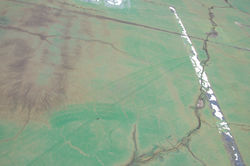
Finally, I assembled all 24,022 photographs—each of my individual steps, and at the same time each moment in which “the site I had constructed” disappeared—and projected them back into its image, rendered in a blurred and ambiguous state.
The low hum of boats filled the air. As the virtual and the real pulled against one another, the boundary between them was continuously erased and softened, until the site ultimately became a transparent object.
Between the rising and falling of the tides.
 24022 來自四年前的一場幻覺 |  |  |
|---|---|---|
 |  |  |
 |  |  |
 |  |  |
 |  |  |
 |  |
Mirage / 海市蜃樓
The architectural mass of the Linhai New Village Parking Structure is surrounded by enormous cranes from shipyards and container yards. Along the harbor, these immense bodies roam freely across the sky. Accompanied by the heavy drone of diesel engines and the intermittent blasts of ship horns, they resemble an advancing army—heads held high, imposing and austere.
And what of this building, whose scale is equally astonishing?
It resembles a stooped and weathered old man, dragging his deteriorating body along the harbor and sighing, dispirited as though he has come to recognize himself as a burden.
This prompted me to use car headlights to project the shadows of objects found on-site—soft, rotting wooden pallets, plastic baskets, cardboard boxes, and other abandoned materials left inside the parking structure—and transform them into temporary photographic images. Much like the building’s own awkward circumstances and uncertain history, birth and decay are entangled here, merging into an indistinguishable mass of flesh and blood.
“A mirage rises from within nothingness and collapses at the moment of its evanescence.”
I chose this method of producing and documenting images because of its inherent temporariness. The artist intervenes only briefly before withdrawing almost immediately, compressing the entire duration of the image—from its formation to its disappearance—into an extremely short span of time.
The moment the headlights are switched off is also the moment when the projected image is stripped away from the site. Its existence is not a permanent condition, but an event briefly staged and manipulated within a specific place.
“In the darkness, I used whatever objects were available to construct cranes and buildings, as though carrying out some kind of ritual.”
I switched on the headlights. Light and shadow drifted and danced, indistinctly, through the depths of the night. The hour was already late enough that the rising and falling tides along the shore could serve as their accompaniment.
I stood there, transfixed, watching.
It felt almost like a moment of farewell.
Raising my camera, I attempted to record the traces of its brief existence—to document the organism temporarily formed by light, shadow, and site within that fleeting period of time. Through this act, I sought to open a dimension beyond myself in which an external and deliberately constructed crystallization of experience could be placed.
I chose photography to preserve a single cross-section of its momentary existence along the timeline because I believe that the projected objects and other elements possessed a position from which to speak only within that particular site and at that particular moment.
Once removed and relocated elsewhere, they might become impoverished and constrained, or even lapse into affectation. For this reason, I chose to record only a fleeting cross-section of their existence in time.
 |  |  |
|---|
Work Shed / 工寮
Text by Huang, Chuhsiang
Participants / Huang, Chuhsiang; Tsai, Shihhsiang; Lin, Lung; Lu, Shaowen; Wang, Yihsiu; Cheng, Yinlien
I ask: What does it mean to live in a place? How can such subtle distinctions be perceived? Familiarity and unfamiliarity continually overlap and alternate, leaving me with the sense that I understand, and yet do not.
You say that because everything changes, there is no need to be overly concerned with what one has gained or lost. One simply has to become accustomed to change.
But I say that I do not believe everything is subject to change. There is a certain feeling that has always remained. It tells me what I should do and promises that it will always stay with me. I believe it is merely expressed in different forms.
Whenever I move from one unfamiliar place to another, I often have barely enough time to catch my breath or think before I must turn around and leave again. Should I not do something before departing?
I search for a way to take root in a barren place, attempting to live with a sense of familiarity somewhere unfamiliar. In doing so, I find myself compelled to make a greater effort to live.
The outward forms of living are clear: eating and sleeping, for instance. Even when these actions take place somewhere different, they are still called eating and sleeping. Yet the inner essence of living remains unsettled, drifting between light and darkness. Unless one pays careful attention, it may suddenly slip away in the blink of an eye, like a Poké Ball thrown wide of its target.
We built the work shed. It sheltered us from the sun, though not from the rain. Crude as it was, it still offered us a place to inhabit—a shelter with a different kind of feeling.
In the blink of an eye, we would have to leave once again. Yet the work shed preserved traces of the life we had lived in this place. It became a record of our attempt to find a way of living.
 |  |
|---|
Xiaogang Squad—Secret Base of the Fortress Against the Evil Deep-Sea Mechanical Empire Activated / 小港戰隊- 小港對深海邪惡機械帝國要塞秘密基地啟用
Participants / Lu, Shaowen; Huang, Chuhsiang; Wang, Yihsiu; Lin, Lung; Cheng, Yinlien; Lee, Tingju
One night, while we were all lying together on makeshift beds on the floor, someone—though I can no longer remember who—suddenly joked that we should come up with a name for our team.
“Let’s just call ourselves the Xiaogang Squad.”
After all, we were already a group of fools gathered together in one place. The name suited us surprisingly well.
In any case, nothing we could come up with would be more absurd than this place itself.
As mentioned in the initial concept of the project, this site exists as a vacuum within its historical context. We brought our individual contexts and texts into the space, filling it with them and creating a platform through which dialogue could unfold.
Because the site lacked a context of its own, we were able to avoid the possibility of our texts being overwritten or transformed by an existing narrative. Instead, we could directly construct a new text belonging both to us and to this place, while using the site to generate an imagined alternate dimension.
Through social media, we published seemingly humorous and playful texts and images, producing a “weak event” suspended somewhere between reality and fiction.
The intention was not merely to attract attention. Rather, we treated social media as a platform that connected the site with the outside world, allowing the project to expand outward from within.
 |  |  |
|---|---|---|
 |  |  |
 |